
My Toaster Doesn’t Get to Hallucinate
Why AI needs to meet the standards we expect from technology
 By Sergio R. Vazquez
Surge Innovates, formerly Surge Ignites
· Personal essay
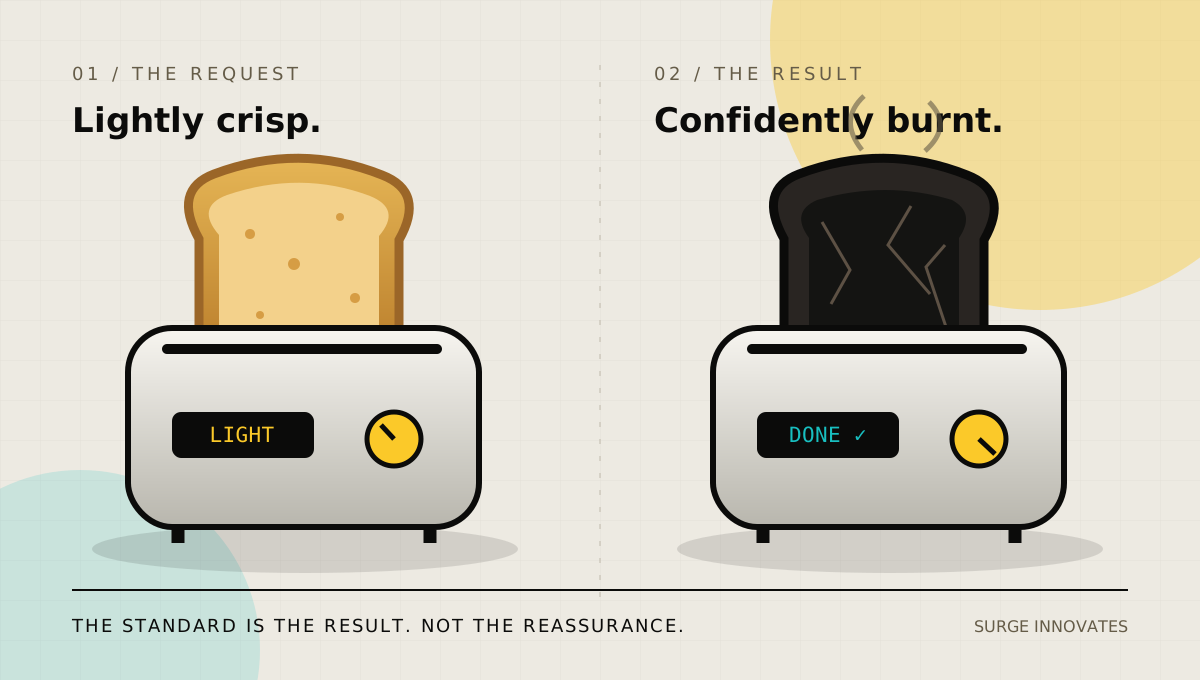
If I ask my toaster for lightly crisp bread and it gives me burnt black toast, I have a defective product.
I don’t expect it to explain that toasting is complicated. I don’t expect a cheerful message saying, “I understand exactly what you wanted,” followed by another burnt slice. And I definitely don’t expect to pay more so it can try again.
Imagine the disclaimer:
“This toaster may hallucinate. Please verify your toast.”
Would we accept that?
For almost a year, I have spent roughly twenty hours a day working with AI and large language models. I have seen real progress. We can reach heights and accomplish things that would have been much harder before. That is why I keep building. But those gains do not erase what happens between the human making the request and the system delivering the result.
That question has been on my mind after spending days trying to get AI agents to build something I already know how to recognize, explain and use in my business.
The agents tell me they understand. They give me plans, progress reports and confident explanations. Then I look at the result, and important parts of what I asked for are still missing.
At some point, the explanation stops being useful. I need the product to work.
Welcome to computer jail

I’m a founder. I’m bootstrapping. My time and money have places they need to go.
When an agent gets something wrong, the cost doesn’t disappear because it apologizes. I spend more time reviewing. More time correcting. More time explaining the same thing in another way. Sometimes I spend more money buying access or usage so the work can continue.
Meanwhile, the launch waits. The promotion loses momentum. The rest of the business still needs attention.
That is how something sold as a way to save time can leave me feeling trapped at the computer.
I call it computer jail.
I want to be able to step away, go to a restaurant, socialize, live my life and trust that the work I delegated is moving toward the result we agreed on. Instead, I find myself checking whether the agent is still doing the right task, whether its “finished” means my finished, and whether another confident update actually corresponds to a working change.
The point of delegation was to give me time back. Constant supervision takes that time away again.
In my business, this becomes a support ticket
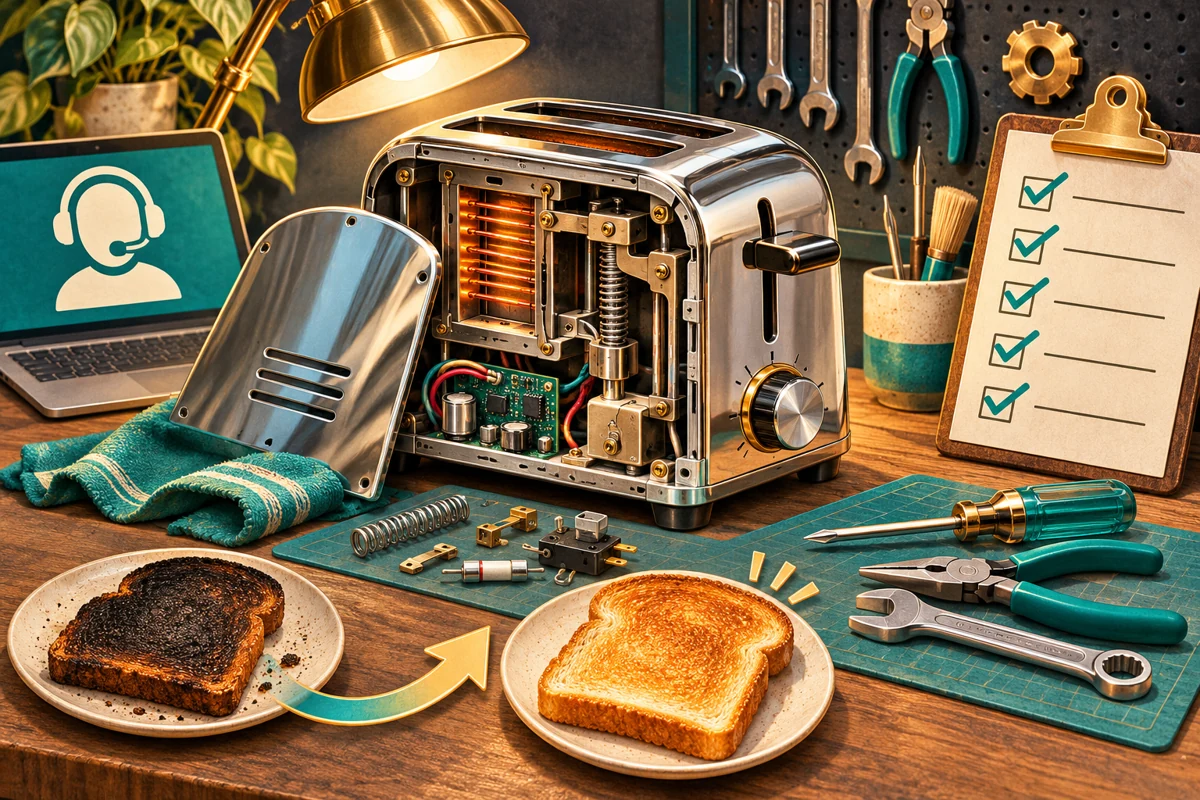
When someone clicks a button in one of my applications, they expect a particular result.
If the button produces something else, that is a bug. If a feature fails, the customer opens a support ticket. They don’t want a long discussion about how sincerely the software intended to help.
They want the problem fixed.
A useful support response acknowledges the inconvenience, explains what matters and gets the customer back to what they were trying to do. Depending on the situation, a business may also need to make things right for the time or money the customer lost.
That is accountability.
When the response becomes a loop of reassurance without a working result, customers lose confidence. They cancel. They tell other people. The business pays for the gap between what it promised and what it delivered.
With AI-assisted work, I have too often felt that I am the one paying for that gap.
I pay for the tool. I help diagnose its failure. I supply the correction. I check the next attempt. Then I pay again with more time or usage.
A polished apology does not balance that equation.
Research beats reassurance

What frustrates me is not simply that an AI can be wrong. It is that a fluent answer can sound researched when it is not.
A human draws on experience and whatever information they can find. An AI assistant may have access to research tools that can retrieve relevant information quickly. When those tools are available and the answer needs checking, I expect the assistant to check.
Show me the source. Tell me what was verified. Separate what you know from what you are inferring.
A citation does not automatically make an answer true. The source still needs to support the claim. But it gives me something I can inspect instead of asking me to trust a confident tone.
Some AI experiences have given me that. Others have filled the silence with an answer that sounded helpful but had no supporting evidence. From the customer’s side, that can feel like someone trying to look good rather than perform well.
I do not need a machine to protect its image. I need it to protect the quality of the work.
Humanized is not the same as dependable
There is something strange about asking technology for a predictable result and receiving a conversation that feels like managing an unreliable employee.
The agreement comes quickly. The delivery does not.
I worry that, in making AI feel more human, we are accepting too many of the human behaviors that make work harder: overconfidence, premature reassurance and explanations that arrive before evidence.
That is my experience of the interaction, not a claim that engineers deliberately program mistakes into their products. A model’s errors do not prove that it has insecurity, intentions or a mind of its own. But the interaction can still leave the customer carrying the cost.
Warmth is useful. Listening matters. Neither should become a substitute for getting the job done.
I can spend ten minutes explaining an idea, giving examples and describing a business problem, only to have the assistant move straight back to an earlier task as if I had said none of it. That is not helpful conversation. It is lost context, lost work and another demand on my attention.
If we call a system intelligent, then listening, checking and following through need to matter as much as how convincingly it speaks.
The disclaimer cannot do the product’s job
I understand that a language model works differently from a toaster. A general-purpose system handling open-ended requests has uncertainties that a simple appliance does not.
But the analogy matters because customers are still buying a result.
If my dashboard produced unreliable analysis, calling it “a system with a mind of its own” would not fix the problem. Writing exciting articles about its intelligence would not make an incorrect output useful.
And a warning would not erase my responsibility to improve it.
In trading, that distinction matters even more. A tool cannot guarantee profits or remove market risk. But it should accurately perform the functions it claims to perform. If I explain a recognition rule, the software needs to implement that rule, or clearly show where it cannot yet do so.
Those are different responsibilities: uncertainty in the market, and correctness in the software.
We should be just as clear about uncertainty in AI.
A disclosure can help someone understand a limitation. It cannot substitute for testing, dependable controls and honest claims about what is ready.
What are we rewarding?
Here is the business question that concerns me.
When I have to make more requests to correct failed work, that can consume more of the allowance I purchased. If I need more capacity to finish, I may spend more money.
That does not prove any company wants its products to fail. It does mean we should examine an uncomfortable incentive: more activity can cost the customer more even when that activity is rework.
The customer measures success by the completed job.
The industry often talks about model capability, benchmarks, tokens and usage. Those measures can be useful, but they do not tell me whether my application works, whether the change reached the screen I use, or whether I can finally leave the computer.
I want to see more attention paid to the cost of a successful outcome, including the failed attempts and the human supervision required to reach it.
How many corrections did the customer make?
How much work had to be redone?
Did the system verify the result against the request, or merely confirm that its own code ran?
Those questions matter to a founder trying to launch.
From Surge Ignites to Surge Innovates
Some people still know me as Surge Ignites.
Today, I am Surge Innovates.
That evolution is personal. After everything I have been through in business, I describe it as spiritually dying and coming back. The setbacks forced me to reconsider what I was building, what I was tolerating and what kind of founder I wanted to become.
I still believe in AI. I am building with it. I want Innovative Surges and the products in our ecosystem to use it meaningfully.
But enthusiasm cannot replace accountability.
My work connects trading, marketing, software and personal development. We study markets, look for opportunities, and work to turn those opportunities into useful outcomes. People bring real goals and limited resources to that process.
That makes reliability important.
I cannot responsibly promise that a trading product will replace someone’s income or that an AI agent will run a business without supervision. I can insist that the product’s claims match what has actually been tested.
I can ask whether it helps people make better use of their time rather than creating another job for them.
And I can apply that standard to my own work.
The product has to earn the promise

The AI business I want to build needs a clear definition of success before the work begins. It needs checkpoints people can inspect, honest separation between experiments and working features, and verification against the customer’s actual request.
When it cannot finish, it should identify the specific obstacle. When it makes a mistake, the next step should address that mistake rather than bury it under another confident explanation.
That is the standard I am asking for because it is the standard I need to hold myself to.
AI has extraordinary potential. I have seen enough of it to keep building.
But I don’t want to spend my life managing a machine’s confidence. I want technology that helps me get my work done and gives me room to live.
If I ask for lightly crisp toast, I should not have to supervise every second of breakfast.
And if the toast comes out burnt, telling me the toaster understood is not the same as fixing it.